Description
Why use a buffer?
With the rise in popularity of true bypass pedals, buffers sometimes get a bad name. Some players have come to associate buffers with tone loss. However, without at least one buffer in your signal path, you may be actually losing tone, particularly your high-end.
Standard guitar signals from passive pickups are quite weak (high impedance). As weak guitar signals travel through yards of wire, switches, jacks, pots, and other components, they can start to degrade. This signal degradation is most often experienced by a loss of high-end frequencies. As your pedalboard gets larger, and/or you are far away from your amp, your guitar can sound duller.
A buffer makes your signal ‘stronger’ (lower impedance) but not louder (unity gain) by converting it into a low impedance signal. A low impedance signal is less subject to degradation.
Our standard (IC) buffer has an input impedance of 1M and an output impedance of <100 ohms. Our transistor buffer has an input impedance of 1M and an output impedance of around 400 ohms.
Click here for an informative video on how a buffer can preserve your tone.
Click here for an article on how buffers work.
Buffer
Saturnworks buffers keep your tone strong and clear over long cable runs.
IC vs transistor buffers
IC versus transistor buffers is subjective and comes down to personal tastes. Since they’re both designed to not sound like anything, We’re talking about very subtle differences. Some players describe IC buffers as clear, clean, or transparent, while transistor buffer are sometimes described as “warmer” or “sweeter.” If you have a preference, we have both flavors.
Our black version features upgraded components including a black powder coated enclosure, premium Switchcraft USA jacks, and a chrome LED holder.
The micro black buffer features upgraded components including a black powder coated enclosure and Japanese Lumberg jacks, all squeezed into a tiny 2″ x 2″ enclosure.
Saturnworks buffers output a very low impedance signal (in the tens of ohms rather than hundreds of ohms). Due to this very low output impedance, lower than most buffers on the market, your signal stays sparkly and clean. Our buffers uses the same circuitry and boutique components used in pedals that cost several times more. Why pay more?
Buffer with Phase Inversion Switch
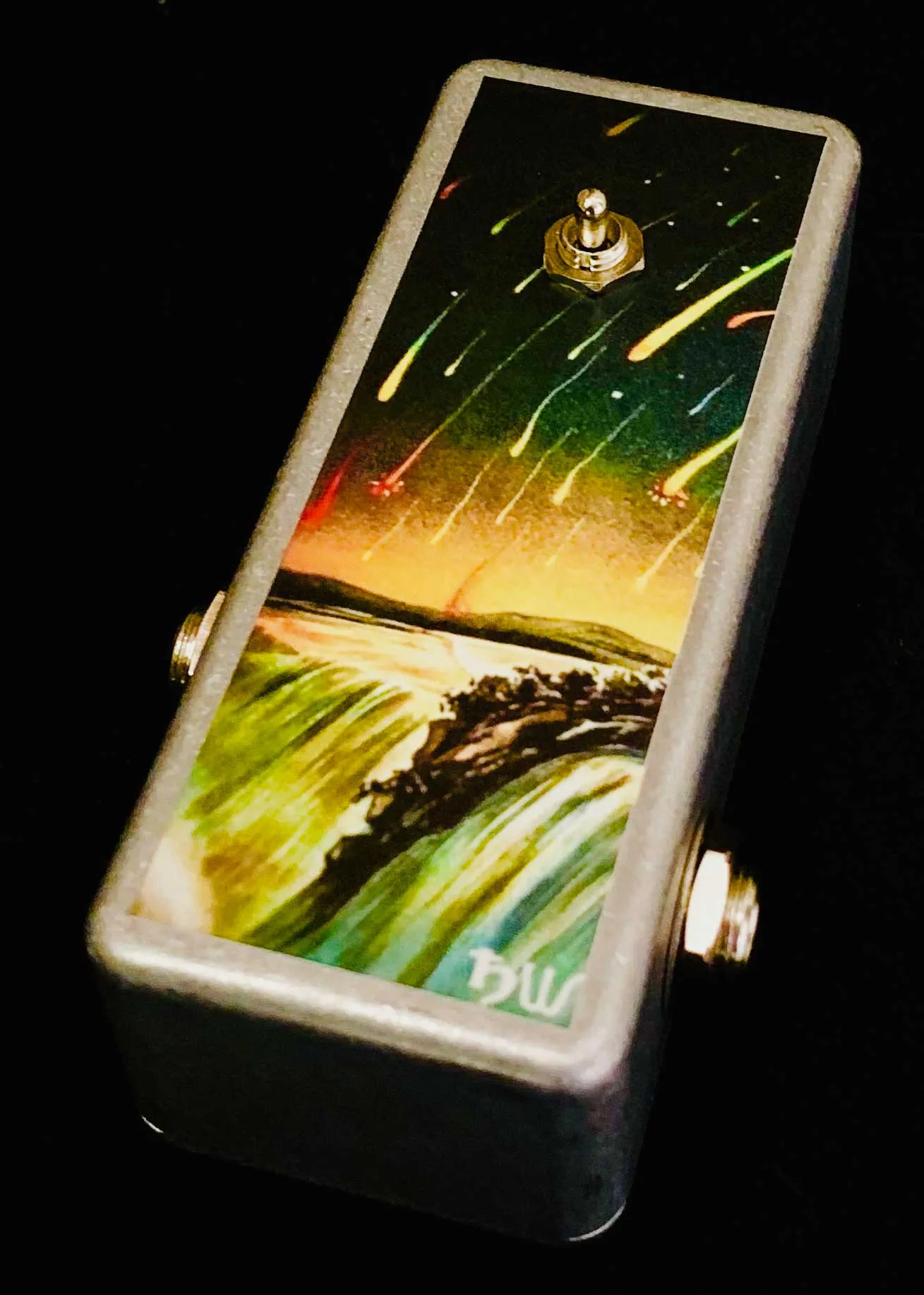
This handy phase inverter can be useful if you’re experiencing out-of-phase issues while splitting or summing multiple signals. It can also just be used by itself as regular buffer. The phase switch flips the phase 180 degrees. Our phase switch is available with either a toggle or footswitch.
There are two ways to invert phase: actively with an IC buffer or passively with a transformer. Our active version is smaller, cheaper, and less noisy than circuits that use transformers.
Buffer with Switch
The switchable buffer is the same high quality circuitry as the standard buffer pedal, but features a true bypass footswitch to turn the buffering circuitry on/off. Please note: switching the buffer on/off may cause a popping sound. However, a buffer isn’t the type of circuit that you would typically switch on/off during a performance or recording, like an effects pedal. Rather, it’s something that you may turn on or off when you’re setting up a rig: either setting it up to be buffered or not. So a one-time pop (if the amp is on for some reason when you’re setting up your rig) is not generally an issue.
Dual Buffer, Dual Buffer with Reversed Top Channel, Dual Buffer with Volume, Dual Buffer with Phase, Triple Buffer and 4-Buffer
The dual, triple, and 4-channel buffers feature two, three, or four separate buffering circuits in one enclosure. You can use these multi-buffers to keep your signal strong both at the beginning of your pedalboard, and again at the end. You can also use them to preserve your signal in parallel setups, or any other application you can think up for multiple buffers.
The dual buffer is also handy to connect your setup using the ‘4 cable method.’
Please note: the default configuration of the is pedal is two inputs on the right and two outputs on the left. However, this can be customized so that the inputs and outputs can be set up on whichever jacks you’d prefer – if you want to set it up on the edge of a pedalboard and want the two inputs to be on the same side, for example. Please contact us for customization options.
The ‘reversed top channel’ version works the same as the standard dual buffer, except that the top channel’s signal flow is reversed, going left-to-right, rather than the standard right-to-left. So the bottom channel is right-to-left and the top channel is left-to-right. This configuration allows you to easily connect the dual buffer to a pedalboard and buffer your setup both at the beginning and end of your pedalboard — both buffering your signal and functioning as a patch bay. You plug the guitar input into the lower right jack, the ‘send’ to your board to the lower left jack, the ‘return’ from your board to the upper left jack, and your amp to the upper left jack.

The dual buffer with volume control features a single volume knob for both channels. The setup makes a great master volume at the end of a stereo pedalboard. The volume control only cuts volume. It does not boost the volume of the channels.
Our dual buffer with phase features a phase inverting switches on each channel. This setup can be useful if you’re sending two signals to two amps in oder to help to correct out-of-phase issues.
Dual Buffer + Effects Loop
The dual buffer + effects loop takes a dual buffer FX loop design and adds a handy tuner out plus a latching kill switch.
You connect your guitar to the input jack. Your guitar signal is then buffered, making it stronger as it goes out to your pedals. Your pedalboard, effects, etc., connect between the send/return jacks. The return signal from your devices is again buffered, ensuring that your signal is strong as it is sent to the output jack and on to your amp.
The dual buffer + effects loop features an always-on turn out jack and a latching kill switch. The kill switch is handy if you’d like switch your signal off as you make changes to your rig, change instruments, take a break, etc. Note: the kill switch only turns off the output, not the tuner out. This allows you to tune while sending your signal to your amp.
Active Splitters
The Saturnworks buffered splitters are the preferred way to split your signal. Saturnworks active splitters feature two separate buffer circuits — one on each output. The dual circuit design works great to prevent signal or level loss. If you’re looking for active/buffered splitters, we have a page dedicated to active splitters with a variety of options.
Active Volume & Active Volume with Switch
The Saturnworks active volume pedal is a volume control plus a buffer in one compact package.
Our Saturnworks active volume pedal has a built-in buffer combined with a 25k audio taper pot to prevent high-end roll-off as you turn down the level and preserve your guitar’s high-end over long cable runs. This pedal is perfect for use at the end of your signal chain to both control the overall level and to keep the signal strong between the pedalboard and the amp.
The active volume with switch features a footswitch that engages/bypasses the volume pot. The buffer circuit is active in the circuit regardless of the switch position.
Active A/B/Y
The Saturnworks active A/B/Y takes a single output and switches it A/B style to one of two outputs (A or B), or, with a second switch, to both at the same time (Y). The active version features a built-in buffer to prevent signal loss in split (Y) mode. The active buffering circuitry also prevents high-end signal loss over long cable runs.
Pan Pedal
Everyone knows how an A/B pedal works…camera one/camera two. How about a pedal that seamlessly pans your guitar back and forth between two amps? Say hello to the Saturnworks pan pedal.
You can set the knob fully counterclockwise for one output, fully clockwise for the other, or anywhere in between to blend the two. The Saturnworks pan pedal uses dual buffers for smooth panning across two outputs without tone loss. If you only have one amp plugged in, you can use the pan pedal as a buffered volume control.
Buffer Looper
The buffer looper preserves your signal while saving space and money by combining a true bypass looper with a buffering circuit. The buffer may be bypassed with a toggle switch so that it works like a regular passive true bypass looper.
Black Blender Buffer
The compact black blender buffer buffers your signal and allows you to dial in a wet/dry mix of whatever is in its FX loop. The blender buffer does not have an on/off switch for the loop. Rather, you can just the control knob to fully wet, fully, dry, 50/50, or anywhere in between. If you just want to use it as a buffer, simply turn the knob fully counter-clockwise. The black blender buffer features premium components including a powder coated black enclosure, Lumberg jacks, and a metal control knob.
Bass Mod
The bass mod allows more lower-range frequencies to enter the circuit. The mod doesn’t cut any highs and therefore can also be used with guitars. If you would like to add a bass mod to any buffer, head on over to our custom upgrades page where you can add this mod at no additional cost.
Upgrades and Customizations
We know you want your pedal to reflect you. We therefore offer a variety of premium upgrades. Customizations and upgrades include powder-coated enclosures, upgraded jacks, and custom graphics. Check out our graphics and customizations page for more information.
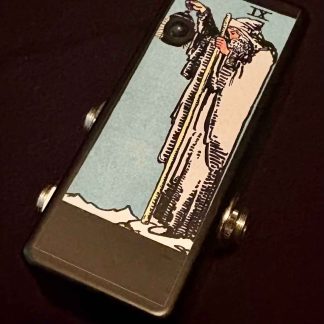
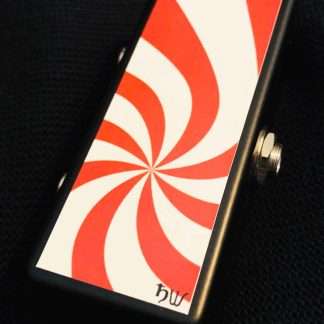
Please note: The pedals in the images are stock photos and not the actual pedals you will receive. The pedals you receive may vary in their graphics, knob colors, and/or LED colors, where applicable. We have our graphics options here.